
Do Subliminals Work? What the Research Actually Says
True subliminal messages can nudge people in the lab, but the effects are small, they can fade within minutes, and they mostly show up when the message matches something the person already wants. When subliminal self-help tapes were put through a careful double-blind test, they did no better than placebo.
That is not the whole story, though. Most of what people call subliminals today, affirmations played quietly under rain or music, are a different thing from the hidden flashes studied in labs. If they help, they probably help the way affirmations do: through repetition, intention, and what you start telling yourself. Here is what the research actually shows, and how to use subliminals in a way that makes sense.

What "subliminal" really means
In psychology, subliminal means below the threshold of conscious awareness. In a typical experiment, a word flashes on a screen for a few thousandths of a second and is immediately covered by another image, so quickly that people cannot report seeing it.
The subliminals on YouTube, TikTok and in apps work differently. They are usually spoken affirmations mixed at a low volume under a background sound. If you turn the volume up and listen closely, you can often hear the words. So in the strict research sense, most of them are not subliminal at all. They are quiet affirmations. That distinction matters, because the two have very different evidence behind them.
The famous claim that started it all
The idea took hold in 1957, when a market researcher named James Vicary claimed that flashing "Eat Popcorn" and "Drink Coca-Cola" during a film had boosted snack sales at a New Jersey cinema. The story caused a panic about hidden advertising. In a 1962 interview, Vicary admitted the study had been a gimmick.
So the most famous subliminal result of all time was not real. But that did not settle the question, and researchers kept testing it properly.
What the lab research does show
Subliminal priming, where a hidden cue slightly shifts a later choice, is a real and well-studied effect. It is just much smaller and more fragile than the hype suggests.
The best-known modern example is a 2006 study by Karremans and colleagues. Participants were flashed the words "Lipton Ice" for a split second while doing an unrelated task, then offered a choice of drinks. The hidden prime made people more likely to choose Lipton Ice, but only if they were already thirsty. For people who were not thirsty, it did essentially nothing. The prime did not create a want. It nudged a want that was already there.
Later work found the nudge does not last long either. In a 2015 set of studies, Smarandescu and Shimp reproduced the effect for thirsty people, then added a 15-minute delay between the prime and the choice. With that short gap, the effect disappeared.
A 2018 review of the field, Subliminal Priming: State of the Art and Future Perspectives, adds one more useful point: primes that people consciously perceive have been shown to have stronger and longer-lived effects on behavior than subliminal ones. In other words, hiding a message tends to make it weaker, not stronger.
The test of self-help tapes
Self-improvement subliminals got their own direct test. In a study published in Psychological Science in 1991, Greenwald and colleagues gave 237 people subliminal tapes sold to improve either memory or self-esteem. Everyone in the study wanted those results. The clever part was that the labels and the contents were swapped for some people, so a tape labeled "memory" might actually contain self-esteem messages.
After a month of listening, neither kind of tape produced its claimed effect. Every group improved a little on both measures, which is what a placebo effect looks like. And more than a third of participants believed they had improved in whichever area was printed on the label, regardless of what was actually on the tape.
That is a sobering result for anyone selling hidden messages. It is also a revealing one. Expectation and the daily act of doing something for yourself mattered. The hidden words did not.

So why do so many people say they work?
When thousands of people say subliminals helped them, it is worth taking seriously rather than laughing off. There are several ordinary explanations, and none of them require hidden messages.
Choosing a subliminal is an act of intention. You decided what you want and you show up for it every day. Writing or picking the affirmations makes the goal clearer. Listening becomes a small ritual, and rituals change how people pay attention: you start noticing moments where you were confident, or calm, or lucky. The background sound itself can be relaxing. And expectation, as the tape study showed, is powerful on its own.
None of this means the change people feel is fake. Feeling more confident is real even if the reason is not a hidden channel into the subconscious.

How to use subliminals in a way that makes sense
If you enjoy subliminals, there is no need to give them up. Just use them for what they plausibly are: affirmations you hear often.
That means the words matter. Write affirmations that are first-person, present tense, and believable to you right now. "I am learning to speak up" will usually land better than "I am the most confident person alive." If a sentence makes you flinch, soften it.
It also means there is no reason to fear hearing the words. Given that consciously perceived messages tend to have the stronger effect, an audible track is a perfectly good choice, and many people like to play a track audibly once so they know exactly what is in it before switching to a masked version.
Most of all, pair the listening with something you do. A confidence subliminal works best alongside one small brave act a day. A study subliminal works best while you are actually studying. Subliminals are not medical treatment, and if you are struggling with your mental health, they are no substitute for talking to a professional.
Making a subliminal you can trust
The simplest way to know what is in a subliminal is to make it yourself. Our free affirmation generator can help you write believable affirmations for a goal, and the free subliminal maker turns them into a track in your browser, with a background sound, an optional binaural beat, and a switch between Masked and Audible so you can hear every word whenever you want.
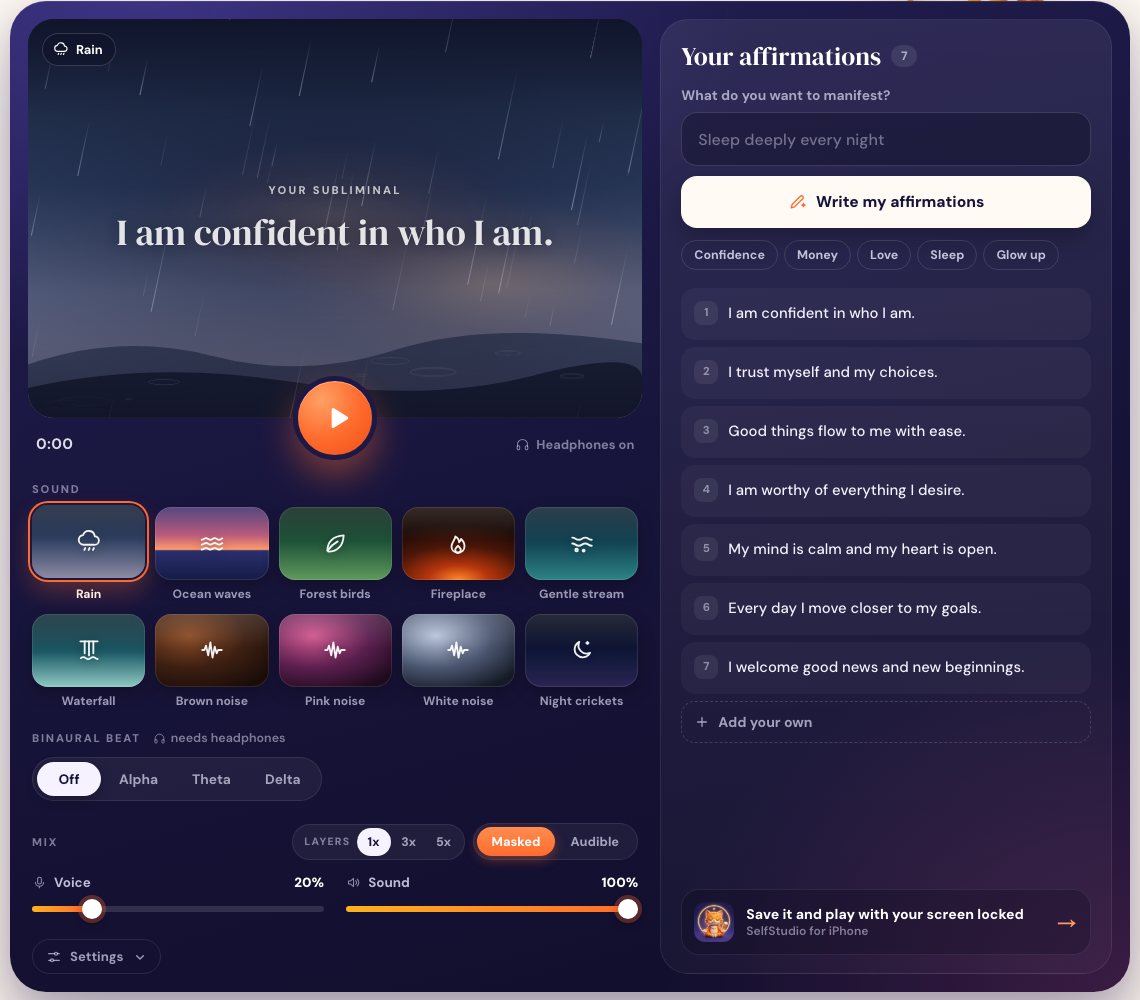
If you want to keep your subliminals on your phone, the SelfStudio app saves them with natural narration voices, plays them with the screen locked, and builds them into a short daily ritual with scripting and a streak, so the habit is easier to keep.
Do subliminals work? Hidden messages on their own are a weak, short-lived nudge, and no one can promise you results. But hearing believable, first-person affirmations every day, while you act on them, is a habit worth keeping. If you are wondering how long to give it, our guide on how long subliminals take to work sets out a realistic routine.