
How to Manifest a Specific Person
If you are reading this, there is probably someone on your mind. Maybe things ended and you cannot stop replaying it. Maybe it never quite started. Either way, you have likely already found the two kinds of advice online: the videos promising a text within 24 hours, and the comments telling you to just move on.
This guide is neither. It is the method most people in the manifestation community actually use, drawn from the teacher Neville Goddard, explained plainly and without promises nobody can keep. The heart of it is simple, and a little surprising: almost all of the work happens in you.

What you are really changing
Neville taught that you never manifest another person's behavior directly. You change your own inner state, the quiet assumptions you hold about yourself and about love, and your world reflects that change back to you. His phrase for this was that everyone is "you pushed out."
It is easy to hear that as "I can make them do things." A more honest reading, and a more useful one, is this: the way you see yourself shapes every relationship you are in. Someone who assumes they are chosen and easy to love does not double-text at 2 a.m., does not read a short reply as rejection, and does not shrink to keep someone around. They show up differently, and people respond to that.
So the goal is not control. It is to become the steadier, more secure version of you, the one who already has the relationship. Whatever happens with this one person, that version of you is worth becoming. And if the practice ever turns into checking their profile every hour or feeling worse after each session, take that as a sign to come back to yourself, not to push harder.
Start with one small scene
Neville's central instruction was to "assume the feeling of your wish fulfilled." To assume a feeling, you need a moment that implies it.
Pick one short scene that could only happen if the relationship were already real. Resist the urge to imagine the wedding or the whole future. Small and ordinary works far better: their name lighting up your phone with "goodnight, love you" and you smiling and putting it down without a second thought. A friend saying "you two are so cute." The two of you on the couch on a random Tuesday, arguing about what to watch.

Good scenes feel a little boring, because that is what a fulfilled desire feels like. It stops being an event and becomes normal life. Write yours down in one present-tense sentence, something like "He texts me goodnight and I feel completely at ease." You will come back to this sentence every day.
Then work on how you see yourself
This is the step most people skip, and it is usually why the practice feels exhausting. If underneath everything you believe "people always leave me" or "I am too much," every technique becomes a fight against that belief, and the belief tends to win.
For a few days, just notice what you tell yourself about love. Write the sentences down without judging them. Then, for each one, write a replacement you could realistically grow into: "I am easy to love." "The people I care about choose me." "I feel secure whether or not my phone lights up."
Keep these believable. In a well-known study on positive self-statements, people with low self-esteem actually felt worse after repeating "I am a lovable person," because the distance from what they currently believed was too big. If a sentence makes you flinch, soften it: "I am learning that I am easy to love." A statement your mind can accept beats a grand one it rejects.
Script it in the morning
Scripting means writing as though the relationship already exists. It works well for a specific person because it lets you rehearse the feeling in detail, calmly, on your own schedule.
Write a few lines in a journal as the future you, describing an ordinary day together. Use the past tense for what happened and the present tense for how you feel: "We got coffee before work and he kept stealing bites of my croissant. I feel so calm with him. I never have to wonder where I stand." End with one thing you are grateful for.

There is a reason this helps beyond manifestation. Psychologists have studied expressive writing for decades as a way to process emotion and quiet rumination. Scripting uses the same mechanism and points it at the future you want instead of the past you keep replaying. Five or ten minutes is plenty.
Feel it as you fall asleep
At night, Neville's technique was SATS, the State Akin To Sleep. As you drift off, the analytical part of your mind quiets, and the scene you hold tends to linger. Sleep researchers call this window hypnagogia, and it is the same window Neville was pointing at.
Lie down, let your body get heavy, and step into your scene from the inside, through your own eyes, not watching yourself like a film. Feel their hand, hear the words, notice the room. Then loop it gently until you fall asleep in it. One scene repeated for a week or two works better than a new one every night. If you want the full walkthrough, our guide to the SATS method covers it step by step.
Keep returning, without checking
Persistence, in Neville's sense, means coming back to your assumption whenever you notice you have drifted into lack. It does not mean scanning their stories for signs.
In practice that looks like: script in the morning, do SATS at night, and in between, live your life. When anxiety shows up during the day, return to your scene for ten seconds and move on. If something disappointing happens, replay it at night the way you wish it had gone, then let it go. Neville called this revision.
The first changes are almost always internal. You check your phone less. A late reply does not ruin your evening. You feel more like yourself. People often notice their interactions with their person shift after this, but even when they do not, this is the version of you that tends to end up in a secure, happy relationship.
Consistency matters more than intensity. Research from UCL found that new habits took an average of 66 days to become automatic. A practice you can keep for two months beats an intense one you drop after four days.
Making it easy to keep
That is the problem SelfStudio was built to solve. You type your goal in one sentence, for example "I am in a loving, secure relationship with Sam," and the app turns it into a short daily ritual: a guided visualization of your scene to step into before sleep, affirmations and a custom subliminal for the night, scripting prompts for the morning, and a streak so you keep showing up.
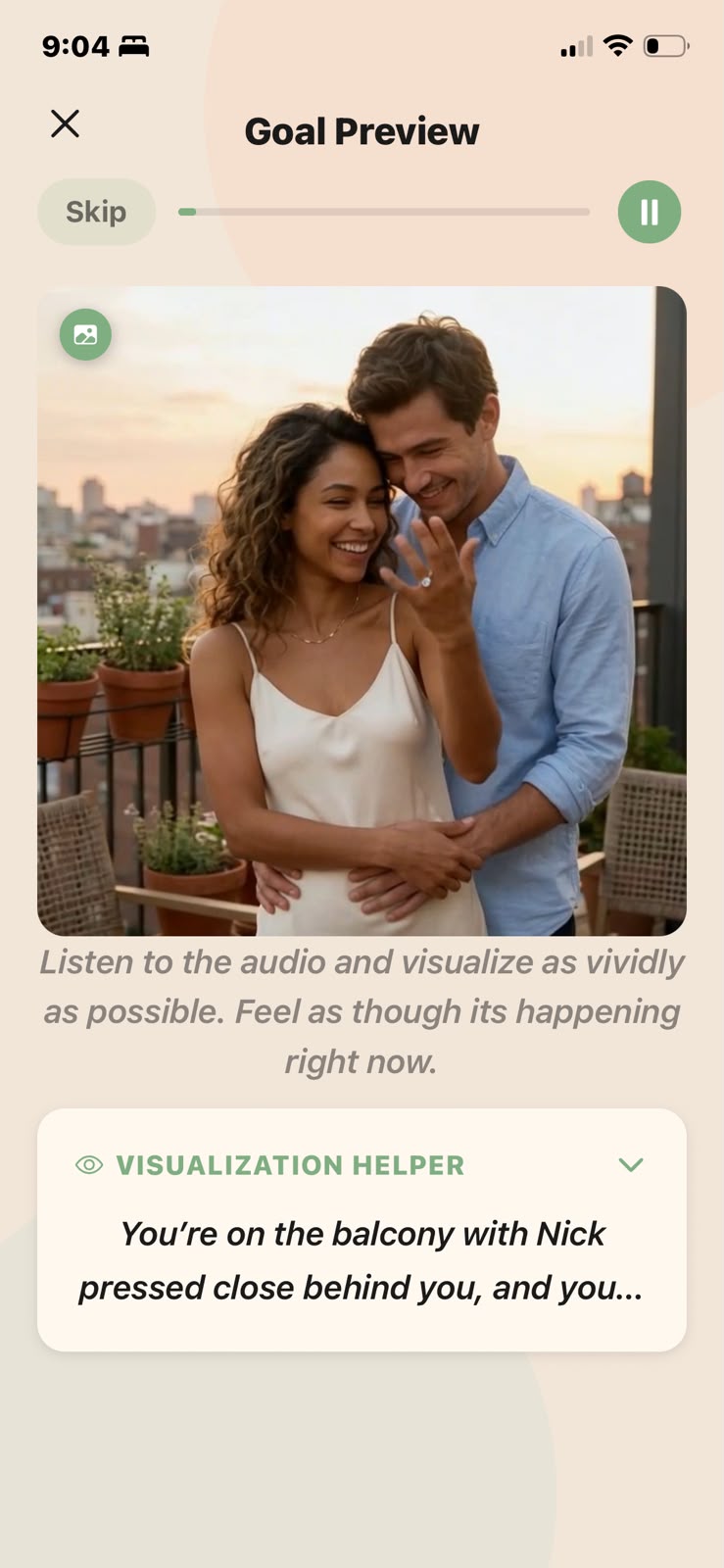
One sentence, "I am engaged to Nick," turned into a guided visualization in SelfStudio.
You do not need an app for any of this. A notebook and a quiet bedtime are enough. An app simply removes the friction, so the practice is still there on the days you would otherwise skip it.
Manifesting a specific person comes down to becoming the person who already feels loved, chosen, and secure. Choose one small scene, be kind and honest with your self-concept, script in the morning, feel it at night, and give it time.
If you want the ritual built for you, download SelfStudio and start with one sentence.