
The SATS Method: How to Do It Tonight
If you have spent any time around Neville Goddard's teachings, you have seen the letters SATS. They stand for State Akin To Sleep, and it is probably the single technique people recommend most. It costs nothing, takes a few minutes, and you can try it tonight in your own bed.
Here is what it is, why the moment before sleep matters, and exactly how to do it.

What SATS is
SATS is the heavy, drowsy, half-awake state you pass through right before you fall asleep. Your body feels weighted, your thoughts slow down and turn into loose images, and the room starts to fade.
Neville Goddard, a mid-century teacher whose lectures have found a huge new audience online, taught that this is the ideal moment to impress a new idea on yourself. In books like The Power of Awareness, he described lying down, relaxing until you feel almost asleep, and then experiencing a short scene that implies your wish has already come true.
The reasoning is intuitive. During the day, part of your mind argues with every hopeful thought: "That is not true, look at your bank account." In the drowsy state, that critic goes quiet. You are not forcing a belief. You are simply feeling it while nothing is pushing back, and letting it be the last thing on your mind before sleep.
Why the moment before sleep matters
You do not have to accept all of Neville's spiritual framework to find this useful, because the window he pointed at is real. Sleep scientists call it hypnagogia, the transition between waking and sleep, when thoughts become dreamlike and many people see vivid fragments of scenes.
Researchers at MIT have even shown that cues presented at this exact moment can steer what people go on to dream about, a technique they call targeted dream incubation. That does not prove anything about manifestation, but it does support the simple idea at the heart of SATS: what you hold in mind as you fall asleep tends to stay with you.

How to do it tonight
First, choose your scene. It should be short, a few seconds at most, and it should be a moment that could only happen after your wish is fulfilled. If you want a new job, it might be a friend at dinner asking how work is going and you saying "honestly, I love it." For money, it might be tapping your card at checkout without glancing at the total. For love, it might be your partner saying "I am so lucky I have you" while you cook dinner. Notice that none of these state the goal. They imply it. You are living in the moment after.
Then get into bed the way you normally fall asleep. Breathe slowly and let your body go heavy, starting at your feet and moving up. Some people count down from fifty. You want to feel almost asleep but still able to hold a thought.
Now step into the scene, and be inside it rather than watching it. Look through your own eyes. Feel the hand in yours, hear the exact words, notice the light and the temperature of the room. Then run it again, and again. It is fine if it starts to blur. Neville said to repeat it until it "takes on the tones of reality," and many people simply loop it until they drift off inside it.
In the morning, do not analyze it. You did the work. Go about your day as the person who already has it.

Where people go wrong
Most of the trouble comes from making it harder than it is. A three-minute story is very hard to hold when you are drowsy, so keep the scene to a few seconds. Watching yourself from the outside, like a movie, keeps the desire "over there," so come back into your own eyes when you notice it. Choosing a brand-new scene every night makes it harder for any of them to feel familiar; one scene repeated for a week or two works better.
And SATS should feel restful. If you are concentrating hard, you have left the state akin to sleep. Lighter is better. The same goes for the daytime: if you spend all day checking for signs that it worked, you are rehearsing the feeling of waiting, which is the opposite of what you practiced at night.
If you cannot see clear pictures in your mind, that is completely fine, and Neville never required it. You can use sound alone, hearing one sentence like "congratulations, you got it." You can use touch, like the weight of new keys in your hand. Or you can simply rest in the feeling of relief. Some people find it helps to watch a short clip of their scene right before bed, which gives the mind something concrete to step into. That is exactly what a mind movie is for.
Making it a nightly habit
SATS works best as part of a small daily rhythm. A few minutes of scripting in the morning, writing as the version of you who already has it, keeps the feeling alive through the day. At night, some people play a quiet subliminal of their own affirmations as they drift off, often with a soft binaural beat underneath. A 2019 meta-analysis found binaural beats had small but real effects on anxiety, which makes them a reasonable addition for winding down.
SelfStudio puts that whole rhythm into one five-minute ritual, built from a single sentence. You type your goal, and the app gives you a guided visualization to step into before SATS, a custom subliminal for the night, scripting prompts for the morning, and a streak so you keep coming back.
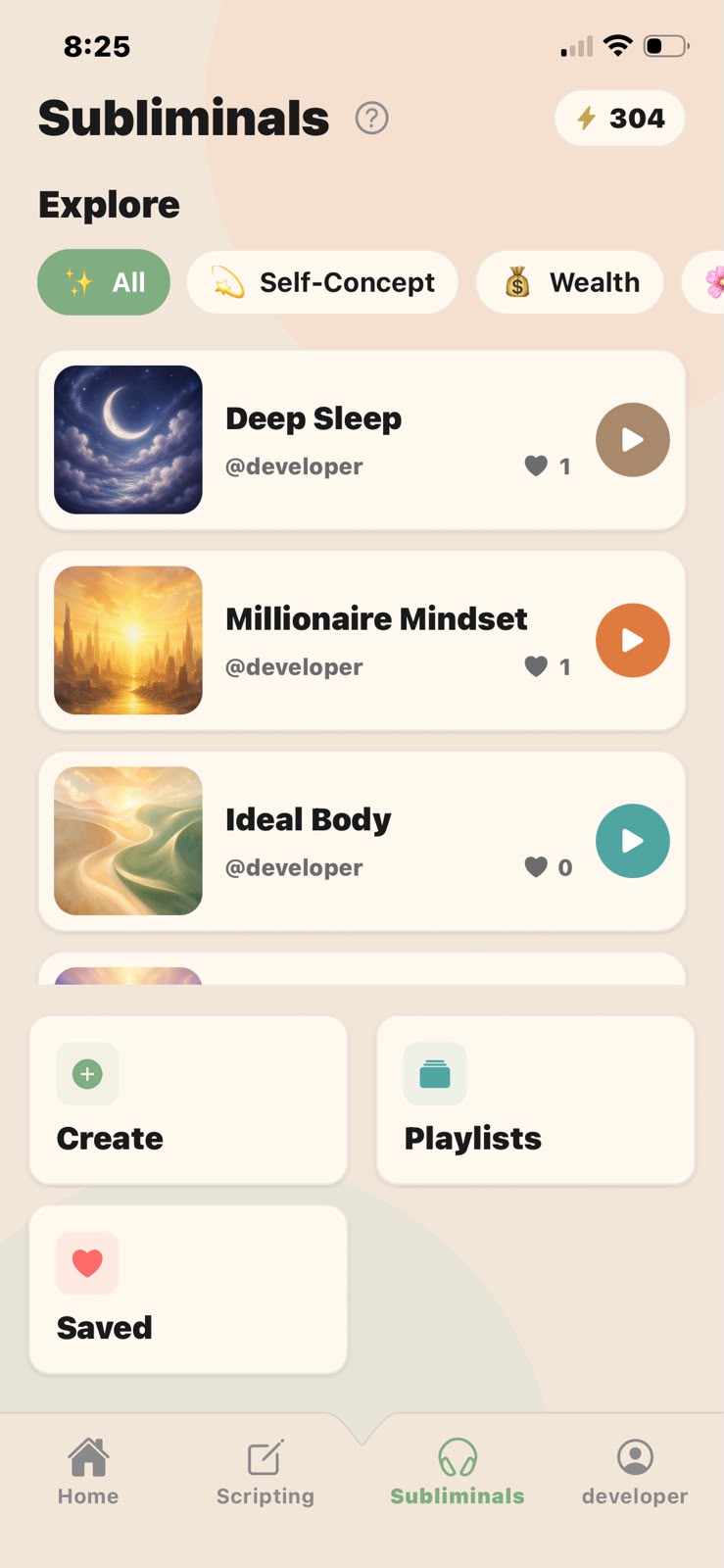
Sleep subliminals in SelfStudio, or make your own from your affirmations.
SATS really is this simple: relax until you are almost asleep, step into a short scene that implies your wish is fulfilled, loop it, and let go. Do it with the same scene each night, keep your days calm, and give it time.
Want a ritual that makes it easy to do every night? Try SelfStudio on the App Store.